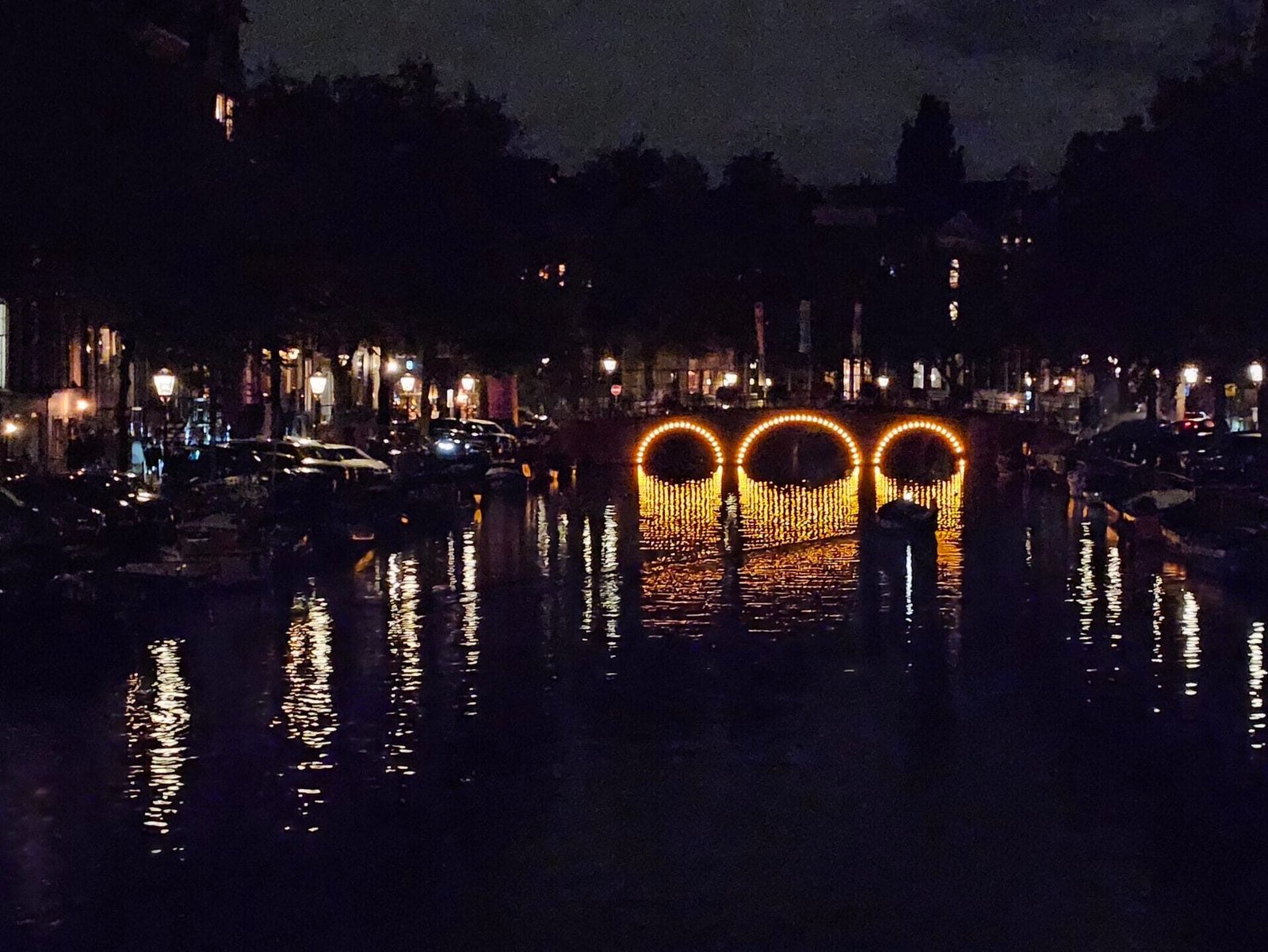
First of all, am I enlightened? Who knows. It’s not important. I just want to share my insights with you because I brought some unusual clarity back with me from last week’s trip to my former hometown, Amsterdam.
What’s enlightenment anyway? Rational nondualism approaches this question more explicitly than is often considered good taste. But good taste doesn’t liberate, so here you go.
In rational nondualism, it’s seeing the world for what it’s not. Once you take away everything the world is not, something is left. That something is the most important “thing” in the world. Because it is the only “thing” there really is.
All the rest of the world consists of artifacts, identities imagined by the human mind for itself so it can move around within “what’s left when all illusions fall away.”
So the self, the others, and the whole world we distinguish are artifacts. They are not “the real thing.”
That real thing is, of course, not a thing.
You can give it many names, but no name captures it. I personally like the word love. Nature works very well too. But I understand others refer to it as God, Brahman, or Tao. In my first books, I called it Tao too.
Sure, none of these are the same once conceptualized. But before conceptualization, they refer to the nondual, so they are logically unable to point to separate “things.”
So where does human suffering come from, the suffering the Buddha was talking about? What’s the infamous samsara about?
It’s the intuitive movement of the mind that goes something like this:
- I feel bad. I don’t feel the love, the happiness, at this moment in my life.
- I don’t want to feel bad anymore. I want to feel good.
- So I must have done something wrong. Or someone else must have done something wrong. Or there must be something wrong with the world.
- So I have to change myself, or you, or the world.
Because one day I will have understood how to secure happiness, how to understand love well enough to meet its conditions. I’ll know exactly what I want and how to get it. And then I won’t feel bad anymore.
In this mental movement, you either imagine that you are the one affected by the world. This is the Orphic archetype: the world is your input and you are its output.
Or you imagine yourself to be the one changing the world. This is the Promethean archetype: you are the input to the world and the world is your output.1
Both are illusions because you are not separate from the “thing”—that same most important and only real thing—so you automatically move with it.
So now you are chasing your tail.
You are trying to do the right thing, be the right person, set things straight. And sometimes you succeed and you feel good. Then you think: Great! I discovered how reality works. I know myself better now. You see? I just had to do my best to become happy and secure love.
But here we stumble on perhaps the greatest illusion: that you can understand love, secure it, discover the conditions under which it can be obtained.
Because love, that single most important and only real “thing” in our lives, is precisely what can never be understood.
Never.
Nor can it ever be secured.
This may sound disheartening, but here comes the true liberation that is referred to as enlightenment: you don’t have to understand love. You don’t have to secure it.
Because you were never separate from it.
You are love, and in absolutely no way distinct from this single most important thing that you cannot understand.
Because there’s nothing else.
Everything that is not love is an illusion.
- Orpheus and Prometheus are protagonists in my latest book “The Nondual Café,” which came out October 6, 2026. You can order it on Amazon. It’s by far my most accessible and clearest book about rational nondualism, and a fun read as well (or so my beta readers told me). ↩︎
Share: